

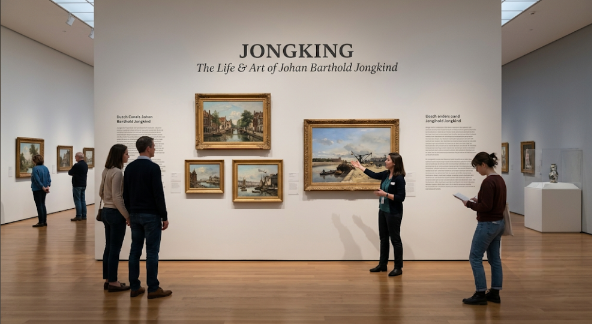
Introduction
The term jongking can be confusing because it is not the standard spelling used by major museums and art collections. In verified art records, the closely related and historically established name is Johan Barthold Jongkind, a Dutch painter, watercolorist, draughtsman, and printmaker who lived from 1819 to 1891. Major institutions including the Rijksmuseum, Metropolitan Museum of Art, National Gallery, and British Museum document his work and career. Understanding this distinction makes it easier to explore the artist, his landscapes, his connection with France, and his important relationship with the development of modern European painting.
What Does Jongking Refer To?
The spelling jongking appears online, but authoritative museum records consistently identify the artist as Johan Barthold Jongkind. The National Gallery of Art lists him as a Dutch artist born in 1819 and deceased in 1891, while the British Museum records him as a painter, watercolourist, etcher, and draughtsman. Therefore, people encountering the alternative spelling may actually be looking for information about Jongkind.
This distinction is important because historical names can appear differently through typing variations, transcription, cataloguing, or online discussion. When researching his paintings, reliable museum collections use “Jongkind.” His documented subjects include landscapes, waterways, ports, villages, city views, and seascapes, making his work especially valuable for understanding nineteenth-century European landscape painting.
Why the Spelling Causes Confusion
A small spelling difference can lead readers toward unrelated results. Some current webpages use “jongking” as a modern keyword, while historical auction and art records occasionally show the spelling in references connected with Jongkind. However, the strongest institutional evidence points to Johan Barthold Jongkind as the established artist’s name.
Who Was Johan Barthold Jongkind?
Johan Barthold Jongkind was born on June 3, 1819, in Lattrop in the eastern Netherlands. According to the Musée d’Orsay, he later studied at the Drawing Academy in The Hague and became a pupil of landscape painter Andreas Schelfhout. His early work reflected the Dutch landscape tradition, especially through canals, mills, low horizons, skies, and carefully observed natural surroundings.
In 1845, painter Eugène Isabey invited Jongkind to Paris, creating an important connection between the Dutch artist and the French art world. Jongkind continued developing his career between the Netherlands and France before eventually spending much of his later life in France. The Musée d’Orsay describes France as his adoptive country and highlights the importance of both his Dutch training and French experience.
From Dutch Landscapes to France
Jongkind’s artistic development was shaped by two environments. His Dutch background gave him a strong foundation in landscape painting, while France exposed him to new artistic circles and subjects. The British Museum records his training in The Hague, his Paris studies beginning in 1846, his return to Holland in 1855, and his return to Paris in 1860.
This movement between countries helped broaden his visual language. Rather than treating landscape as a fixed formula, he became increasingly interested in changing light, atmosphere, weather, water, and fleeting visual impressions.
The Artistic Style Behind Jongkind
One reason Jongkind remains interesting is his approach to atmosphere. The Musée d’Orsay explains that his early landscapes retained elements of seventeenth-century Dutch tradition while placing strong emphasis on light and atmosphere rather than simply presenting picturesque scenery.
His working process also shows an unusual balance between observation and studio composition. The National Gallery notes that he frequently created drawings and watercolor sketches from a scene before using them as foundations for oil paintings. This approach allowed him to capture immediate impressions while developing a more finished composition later.
Watercolor, Oil, and Etching
Jongkind worked across several mediums. Museum records identify oils, watercolors, drawings, and etchings among his surviving works. The British Museum specifically describes him as a painter, watercolourist, and etcher, while the Metropolitan Museum holds both oil and watercolor examples.
His versatility matters because each medium served a different purpose. Watercolors and sketches could record changing conditions quickly, while oil paintings allowed him to develop broader compositions. His etchings provide another perspective on his interest in landscape and place.
Important Works Associated With Jongkind
Several museum collections preserve works that demonstrate the range of Jongkind’s artistic interests. The Rijksmuseum, for example, holds Rotterdam in the Moonlight, an 1881 oil painting depicting a Rotterdam canal at evening with boats, buildings, and a church tower in the distance.
The Metropolitan Museum also holds Honfleur, painted in 1865 during Jongkind’s third visit to the Normandy coastal town. The museum notes that Claude Monet was also working in Honfleur during the 1860s, placing Jongkind within an important artistic environment.
The Boulevard de Port-Royal, Paris
The National Gallery in London preserves The Boulevard de Port-Royal, Paris, dated 1877. The museum explains that Jongkind made several views of the boulevard near his Paris studio and often developed oil paintings from earlier drawings and watercolor studies.
The work also demonstrates changes in his later style, including looser brushwork and strong dark outlines around elements such as buildings and streetlamps. These details show how his technique evolved throughout his career.
Jongkind and the Impressionist Generation
Jongkind’s historical importance becomes clearer through his relationship with artists associated with Impressionism. The National Gallery states that his work was admired by Alfred Sisley and Claude Monet and that both were influenced by the older artist.
The Van Gogh Museum’s published collection research gives an especially revealing account. Claude Monet later credited Jongkind with helping train his eye, demonstrating how seriously Monet regarded the Dutch painter’s influence.
This does not mean Jongkind should simply be classified as an Impressionist. He developed his own approach before the movement became established. His importance lies partly in the way his interest in light, atmosphere, outdoor observation, and rapid visual notation anticipated qualities that later became central to Impressionist painting.
Why His Influence Still Matters
Jongkind provides an important link between established Dutch landscape traditions and newer nineteenth-century approaches to painting. His work shows how artists could preserve careful observation while becoming more interested in changing light and personal visual experience.
That combination helps explain why museums continue to preserve, research, and exhibit his paintings. His career also demonstrates how artistic influence can cross national boundaries, with Dutch training, Parisian experience, and relationships with French artists all contributing to his legacy.
Where Can You Find Jongkind’s Art Today?
Major international museums hold works by Johan Barthold Jongkind. The Rijksmuseum has paintings and prints connected with Dutch landscapes and Rotterdam, while the Metropolitan Museum of Art preserves works including Honfleur and Wind Mill at Antwerp.
The National Gallery of Art in Washington, D.C., lists 22 works by Jongkind in its collection, including The Towpath, an 1864 oil painting. The British Museum also maintains a substantial record of his prints and biography.
Exploring His Work Through Museum Collections
Museum databases are particularly useful for anyone researching jongking because they provide verified names, dates, materials, dimensions, provenance, and historical context. Instead of relying on an isolated online description, readers can compare records from established institutions.
The Musée d’Orsay has also devoted an exhibition to Jongkind, reflecting the continued scholarly interest in his career and artistic development. These collections make it possible to study his work across different periods and mediums.
Why Jongking Is Still a Useful Search Term
Although “jongking” is not the standard name used in major museum catalogues, it can lead people toward the broader subject of Johan Barthold Jongkind. Understanding this connection prevents confusion and helps researchers find authoritative information about the artist.
The most useful approach is to recognize the spelling variation while using “Jongkind” when checking historical records, museum catalogues, and artwork details. This matters especially when searching for specific paintings, dates, exhibitions, or provenance information. Verified sources consistently provide the artist’s established name, life dates, and artistic background, making them a stronger foundation for further research.
Conclusion
The story behind jongking ultimately leads to Johan Barthold Jongkind, a Dutch-born artist whose career connected nineteenth-century Dutch landscape traditions with the developing French art scene. His paintings, watercolors, drawings, and etchings reveal a lasting fascination with light, atmosphere, waterways, cities, and everyday landscapes. His influence on artists such as Claude Monet and Alfred Sisley also gives him an important place in the history of modern European painting. While “jongking” appears as a spelling variation online, readers looking for reliable historical information will find the strongest documentation under the name Johan Barthold Jongkind.
FAQs
1. Is Jongking the correct spelling of the artist’s name?
No. Major museum records identify the artist as Johan Barthold Jongkind. “Jongking” appears online as a spelling variation, but Jongkind is the established historical spelling.
2. Who was Johan Barthold Jongkind?
Johan Barthold Jongkind was a Dutch painter, watercolorist, draughtsman, and printmaker born in 1819. He spent much of his later career in France and influenced younger artists.
3. What subjects did Jongkind paint?
He frequently painted landscapes, canals, rivers, ports, coastal scenes, city views, boats, mills, and changing atmospheric conditions across the Netherlands and France.
4. Did Jongkind influence Claude Monet?
Yes. Museum documentation records Jongkind’s influence on Monet, while the National Gallery identifies Monet and Alfred Sisley among artists who admired and were influenced by his work.
5. Which museums have Jongkind’s artwork?
His works can be found in major collections including the Rijksmuseum, Metropolitan Museum of Art, National Gallery of Art, National Gallery London, and British Museum.









Leave a Reply